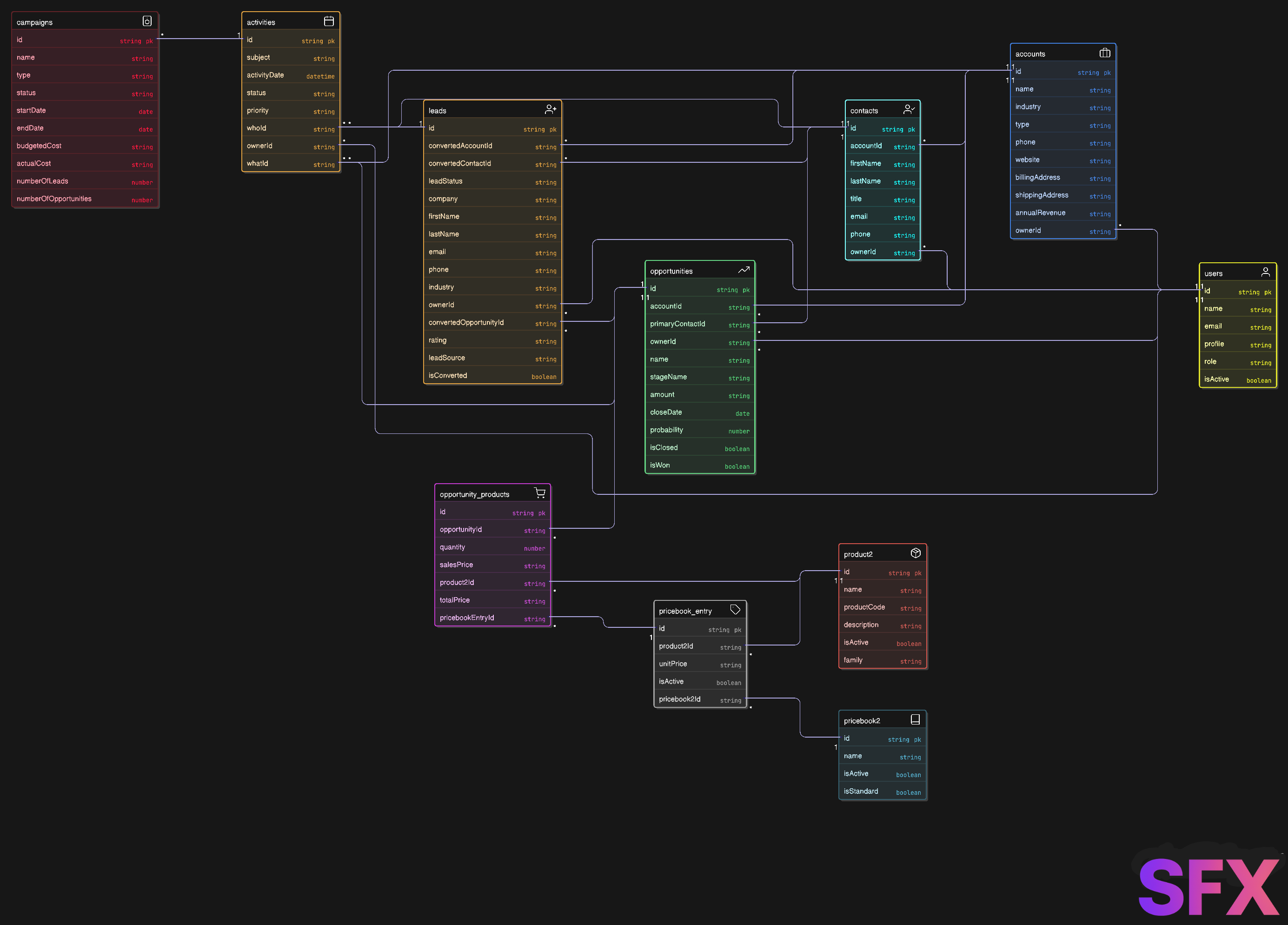
A formal, comprehensive reference for all key objects and relationships in Salesforce Sales Cloud — suitable for architects, developers, and decision makers alike.
Figure: Conceptual class diagram of Salesforce Sales Cloud.
1. Standard Objects Overview
Salesforce Sales Cloud consists of these core objects. Each serves a distinct role in supporting the sales lifecycle:
Object
Purpose
Key Attributes
User
Represents a Salesforce user (salesperson, manager, admin, etc.).
One-to-many, loosely coupled. Child can exist without parent. Example: Contact to Account.
Master-Detail Relationship
One-to-many, strongly coupled. Child cannot exist without parent. Roll-up summaries allowed. Example: OpportunityLineItem to Opportunity.
Many-to-Many (Junction Object)
Implemented with a junction object — e.g., CampaignMember links Campaign to Lead/Contact.
Self & Hierarchical Relationships
Object references itself (e.g., Parent Account), or special User management hierarchy.
Special: Lead Conversion
Business process where a Lead is converted into Account, Contact, and Opportunity.
3. Automation & Business Processes
Salesforce Flow: Automates lead nurture, assignment, approvals, and notifications.
Einstein AI: Predictive lead scoring, opportunity forecasting, recommendations.
Assignment Rules: Automatically route leads to the right reps/queues.
Validation & Duplicate Rules: Ensure data quality and block duplicates.
Roll-ups & Reporting: Summarize child records, visualize KPIs on dashboards.
4. Textual Class Diagram
User
 └─ owns → Lead
      └─ converts to → Account
           ├─ has → Contact
           │     └─ can be → Opportunity.PrimaryContact
           └─ has → Opportunity
                 └─ has → OpportunityLineItem
                        ├─ refers → Product2
                        └─ refers → PricebookEntry
Pricebook2
 └─ has → PricebookEntry
Campaign
 └─ influences → Lead / Opportunity / Contact
Activity
 └─ related to → Lead, Account, Contact, Opportunity
5. Conclusion
This formal class diagram and overview summarize the architecture and automation that make Salesforce Sales Cloud a leading CRM platform. Understanding these objects and relationships is key to building scalable, maintainable, and effective sales solutions.